Automation should liberate humans from tasks that machines can perform, not eliminate the human role in determining the direction of life. This is because technology should be a tool for human progress, while wisdom, responsibility, and moral values must remain the guides in its use.
THE scientific oration titled “AI and the Future of Higher Education” delivered by the Head of LLDIKTI Region VII, Prof. Dr. Dyah Sawitri, SE., MM., at the 24th Graduation Ceremony of the Cendekia School of Economics (STIEKIA) on October 24, 2026, was very interesting and highly relevant to the impact of current technological advancements. One of the issues she analyzed was the “Critical Threat Behind Automation.” This article intends to briefly examine one of the fundamental aspects of automation and its connection to human life, especially the world of work.
Automation has become an attention-grabbing part of modern technological development. Tasks that previously required human effort, time, and direct involvement can now be performed by machines, robots, or software. In the industrial world, automation accelerates production processes. In the banking sector, transactions can take place without having to meet an officer. Meanwhile, in the world of education and office work, various administrative tasks are beginning to be completed automatically with the help of Artificial Intelligence (AI).
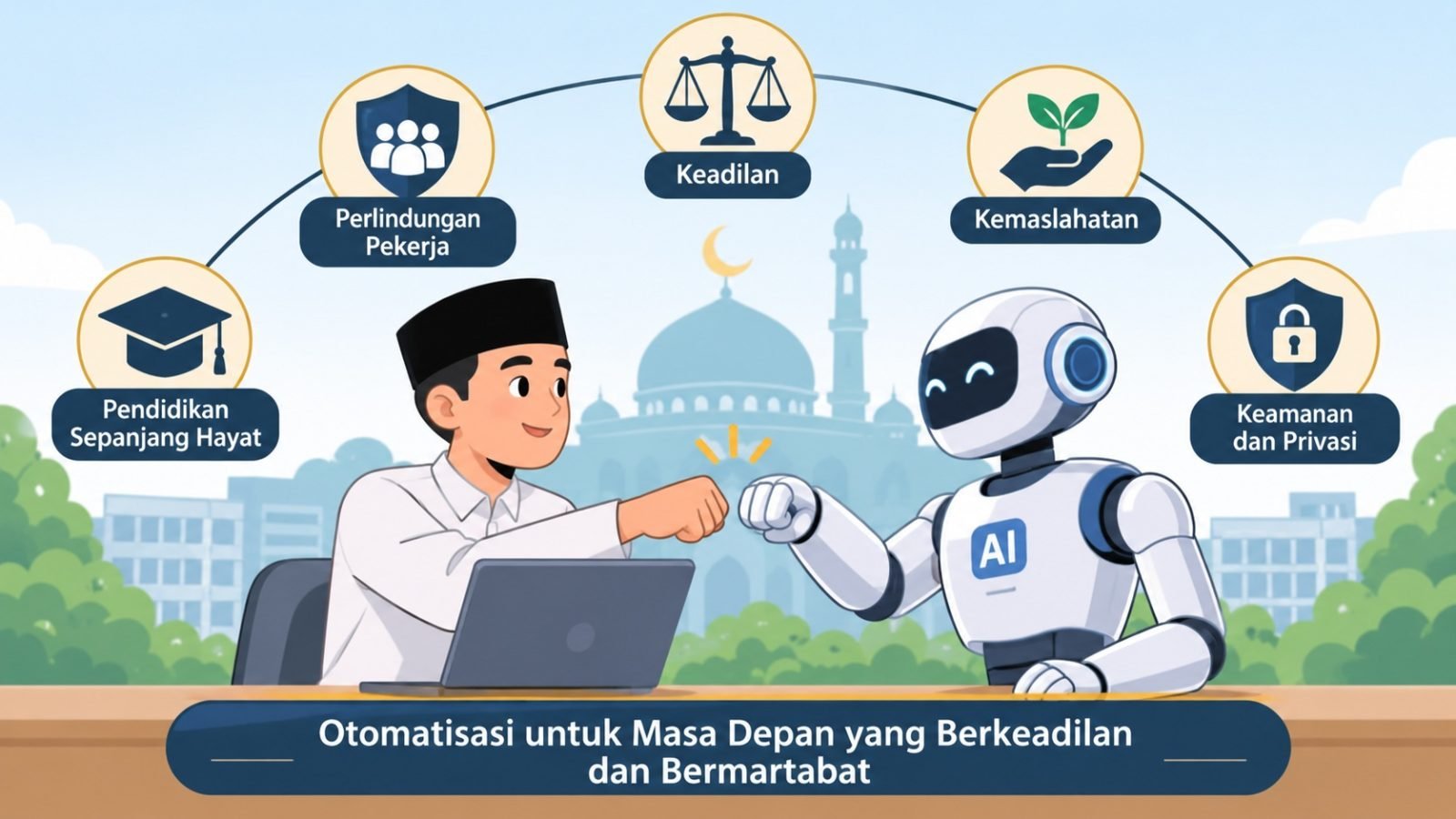
This development brings tangible benefits. Work becomes faster, operational costs can be reduced, and productivity increases. However, these benefits do not automatically make human life better. Automation must be directed toward fair and responsible human-technology collaboration, where: technology takes over tasks that can be performed more effectively by machines, while humans retain control over decisions, values, and the direction of its use.
This issue can also be contemplated through an Islamic perspective. The Qur'an places humans as caliphs on earth (QS Al-Baqarah [2]: 30), a mandate that carries the responsibility to manage life wisely. In technological development, this mandate can be realized through the use of human knowledge and ability to bring about benefit (Estede, 2025). Technological progress needs to be directed to provide broad benefits, maintain justice, and not ignore human dignity.
This thesis is important because automation is not just a matter of machines replacing human labor. Furthermore, automation relates to the future of work, the distribution of welfare, the human ability to make decisions, and the position of humans in a system increasingly controlled by technology. Therefore, the success of automation, besides being measured by speed or cost savings, must also be seen from its ability to expand benefits, protect vulnerable groups, and maintain human dignity.
Automation and Changes in the World of Work
One of the most tangible impacts of automation is the change in the employment structure. Jobs that are routine, repetitive, and follow specific procedures are relatively easier to transfer to machines or digital systems. At the same time, technological development also creates a need for new jobs that require analytical skills, creativity, technology management, and problem-solving.
The World Economic Forum (2025), in its The Future of Jobs Report 2025, estimates that various structural changes up to 2030 will create about 170 million new jobs and displace about 92 million existing jobs globally. Overall, these projections result in a net growth of about 78 million jobs. This figure is an estimate based on employer surveys and trend analysis, not a certainty that every country will experience the same changes.
These findings show that automation does not always mean the total loss of jobs. The problem lies in the types of jobs that change, the skills required, and the ability of the workforce to adapt. Therefore, fair automation must be understood as a transition process that involves workers, not just a technical decision to replace human labor.
This is where the real challenge arises. Workers who lose their jobs do not necessarily have the skills suitable for new jobs. Rapid technological changes can also make previously valuable skills less relevant.
The International Labour Organization (ILO, 2025) emphasizes that the influence of AI on the world of work includes both opportunities and risks, including the possibility of certain jobs being displaced and the emergence of new employment opportunities.
Thus, the challenge of automation is not merely how companies adopt technology, but also how education, training, the business world, and the government prepare humans to face these changes. Human-technology collaboration can only take place responsibly if workers obtain real opportunities to learn, adapt, and enjoy the benefits of increased productivity.
From an Islamic ethical point of view, this change also concerns responsibility toward fellow human beings. The decision to adopt technology should consider its impact on workers and their families. Corporate efficiency indeed needs to be maintained, but economic interests should go hand in hand with social concern. The ability to use technology becomes more meaningful when the results also improve human life.
The Threat of Dependence on Technology
The threat of automation does not stop at the issue of work. When more activities are handed over to automated systems, humans also face the risk of excessive dependence.
Suprapto Estede in his book “From TAM to ITAM: Weighing Technology with Faith” (2026: 16) explains that technology is never neutral. Technology carries a certain logic, value, and direction that subtly influences the way we think and act. Besides helping our decisions, in many situations, it even shapes the decisions themselves. Technology that was originally used to assist decision-making can turn into the only reference. A person might accept the results of a system analysis without checking their truth, follow algorithmic recommendations without considering the actual circumstances, or surrender important judgments to machines just because the results look objective. In fact, automated systems work based on specific designs, data, and rules. If the data used is inadequate or contains bias, the results provided can also be wrong. Even systems that work very quickly and consistently are not necessarily able to understand the entire social, cultural, and moral context of the problems faced by humans.
The National Institute of Standards and Technology (NIST), through its AI risk management framework, emphasizes the importance of identifying risks, measuring impacts, and managing AI systems responsibly. Tabassi (2023) explains that the framework is designed to help organizations increase trust in AI systems while reducing their potential negative impacts. This means that decisions involving human interests cannot rely solely on technical accuracy. Supervision, transparency, clarity of responsibility, and ethical considerations are also needed. In a healthy collaboration, technology provides recommendations or support, while humans retain the authority to evaluate, correct, and reject system results if they are not in accordance with the context or principles of justice.
This principle is in line with Islamic teachings that emphasize responsibility for knowledge and actions. QS Al-Isra' [17]: 36 reminds humans not to follow something they do not know well, because hearing, sight, and the heart will be held accountable. In digital life, this message is relevant as an encouragement not to blindly accept information, recommendations, or technological decisions.
The verse is not a specific discussion about AI, but the principle of caution it contains can be an ethical foundation in facing technology. The ease of obtaining answers does not erase the obligation to check the truth. The speed of a system does not replace moral consideration, and the sophistication of a machine does not free humans from responsibility for the decisions they make.
In the field of education, for example, AI can help lecturers prepare teaching materials, process data, and provide feedback. However, such technology should not eliminate the role of the lecturer in guiding, assessing character development, and understanding the needs of students as humans.
Technology can assist the educational process, but education still requires human relationships. Thus, automation must strengthen the capacity of educators, not replace their responsibility in building knowledge, character, and social concern.
When Efficiency Displaces Human Values
One of the fundamental issues in automation is the tendency to make efficiency the primary measure of success.
In the business world, efficiency is indeed a primary matter. Companies need to increase productivity, control costs, and maintain competitiveness. However, if efficiency becomes the only consideration, the human aspect can be ignored.
Imagine a company that is able to increase profits through automation, but at the same time reduces its workforce without providing adequate training or transition support. Economically, the decision might look rational for the company. However, its impact on workers, families, and society needs to be taken into account.
Similar problems can arise in public services. Automated systems are able to speed up administrative processes, but they are not necessarily able to provide the right response to someone facing special circumstances. When all services are forced to follow digital procedures without adequate alternatives, groups with limited access or digital skills are at risk of being left behind.
An OECD study (2024) on the use of AI in the workplace also identified a number of risks, including increased work intensity, issues of data collection and use, and the potential for increased inequality. Therefore, the success of automation should be judged through broader measures than just speed and cost savings. Productivity needs to go hand in hand with worker protection, equitable distribution of benefits, respect for privacy, and improvement in the quality of life. Every application of technology also needs to consider who benefits, who bears the risks, and whether there are mechanisms to correct harmful impacts.
This is where the value of justice in Islam finds its relevance. Justice demands that the interests of the strong party do not become the only basis for decision-making. In the application of automation, this principle can be realized through the protection of workers, more equitable access to technology, and the sharing of benefits that do not only benefit the owners of capital.
Islam also teaches that wealth and ability are mandates that must be used responsibly. Therefore, economic success obtained through technology needs to be assessed along with its impact on the life of society. Increased profits are a business achievement, but fair progress requires attention to those at risk of being left behind.
Efficient technology is not necessarily humane if its benefits are only enjoyed by some parties, while the risks are borne by others.
Turning Automation into Collaboration
Facing these various risks, the available choice is not to reject automation entirely or accept every technological development without consideration. A wiser approach is to build a working relationship that allows humans and technology to complement each other fairly and responsibly.
In this approach, machines take over repetitive work, while humans remain involved in judgment, creativity, decision-making, and responsibility. Technology is used to expand human capabilities, not just reduce their involvement. Thus, automation is not positioned as a replacement for humans, but as a means to help humans work more safely, meaningfully, and productively.
The OECD (2024) shows that the use of AI can provide benefits for worker performance, but those benefits depend on how technology is applied and how the risks that accompany it are managed.
The spiritual perspective of Islam can enrich the way we evaluate this process. Mastery of technology is part of the human endeavor to develop knowledge and improve life. However, endeavor requires moral direction. The ability to create something does not by itself determine whether that thing is worth doing. Questions about benefits, justice, and responsibility need to accompany questions about technical ability.
To realize this collaboration, there are at least four steps that need to be considered.
First, strengthening education and lifelong learning. Education needs to equip humans with digital literacy, critical thinking skills, creativity, communication, and problem-solving skills. Technical skills must go hand in hand with the ability to understand human problems. Lifelong learning also needs to be available for affected workers so they do not bear the burden of transition alone. Education also needs to foster integrity and responsibility, so that the skill to use technology is accompanied by wisdom in determining its purpose.
Second, preparing worker protection and transition. Companies and the government need to provide retraining, upskilling, and support for workers affected by technological changes. The automation process must be accompanied by dialogue with workers, social protection, and a fairer distribution of productivity benefits. Concern for workers reflects the recognition that humans have dignity that should not be sacrificed just for the sake of pursuing efficiency.
Third, building responsible technology governance. The use of automated systems needs to be accompanied by testing, supervision, data protection, and accountability mechanisms. The greater the impact of a decision on human life, the greater the need for adequate supervision. Systems must also be explainable, auditable, and correctable when they produce biased or harmful decisions. In an Islamic perspective, this relates to the mandate: every authority, including the authority to use technology to influence the lives of others, must be exercised responsibly.
Fourth, placing human values as the primary consideration. Decisions regarding the use of automation, besides having to take into account organizational profits, must also weigh justice, human dignity, safety, and the welfare of society. In services involving basic rights, there must be an option for human assistance so that no one is marginalized by digital systems. The principle of benefit reminds us that technology is worth developing and using as long as its benefits can be accounted for and its risks are managed appropriately.
These four steps show that the future of automation is not only determined by the sophistication of machines. That future is also determined by policies, organizational choices, the quality of education, and the values that guide humans in using technology. Fair human-technology collaboration does not happen by itself; it must be designed through rules, investment, supervision, and commitment to the public interest.
Closing: Who Controls Whom?
Automation is part of the progress of civilization that is difficult to avoid. Technology can help humans work faster, reduce certain errors, increase productivity, and open up new opportunities. However, these benefits do not appear automatically. Everything depends on how technology is designed, applied, and controlled.
The main challenge is preparing humans to be able to face change. The greatest threat arises when efficiency defeats justice, dependence weakens independence, and technological sophistication makes humans ignore their own responsibilities. Therefore, automation must be directed toward collaboration that places humans as responsible decision-makers, not as passive objects to technological change.
For a Muslim, this issue also touches on how to understand the mandate as a human being. The ability to think, create technology, and develop knowledge is a gift that carries responsibility. The position of humans as caliphs on earth invites us to view progress not only from what can be created, but also from how the results of that creation are used and who benefits from them.
With this perspective, technology does not have to be pitted against spirituality. On the contrary, technological progress can be a space to realize values of goodness: helping others, expanding access to knowledge, reducing dangerous work, and improving welfare. The condition is that humans retain moral awareness and do not surrender all their considerations to machines.
So, we need to distinguish between technological progress and the progress of civilization. Technological progress is measured by the ability of machines to do more things faster. The progress of civilization should also be measured by the ability of humans to use technology wisely, fairly, and responsibly.
Suprapto Estede, writer and associate professor at STIEKIA.