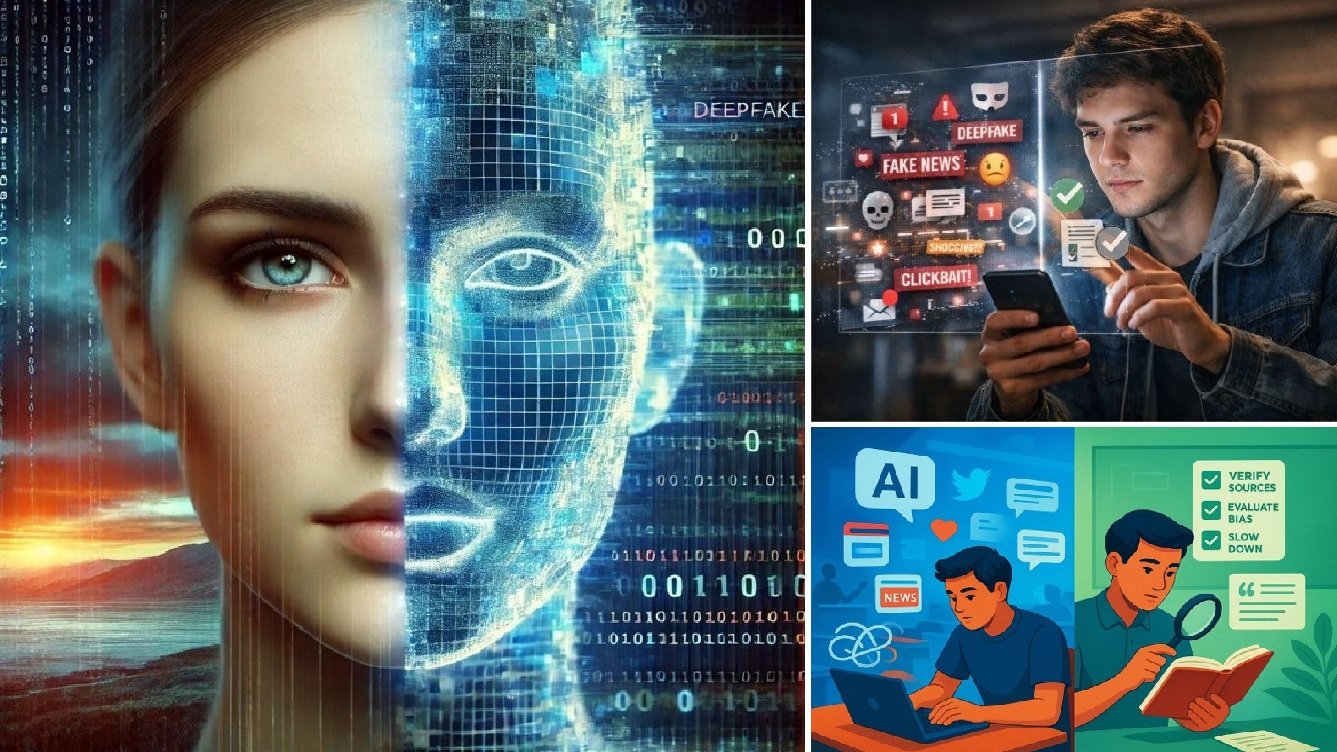
As technology becomes increasingly capable of making falsehoods resemble reality, humans are required to be more mature in checking before believing, thinking before sharing, and being responsible before using the sophistication they possess.
In the era of artificial intelligence (AI), the technological ability to create images, sounds, and videos that appear real has developed very rapidly. Now, a person can be made to appear as if they are saying something they never said, present in a place they never visited, or performing actions that never happened at all. This type of technology is known as deepfake.
This development brings two faces at once. On one hand, deepfakes open opportunities for education, the creative industry, filmmaking, communication, and various other fields. On the other hand, they present serious problems concerning privacy, security, reputation, and even public trust.
At this point, the issue of deepfakes actually becomes broader than just a technological problem. It touches on a very fundamental issue: how do humans ensure the truth when something false can appear so convincing?
When the Fake Looks Real
The term deepfake comes from a combination of the words deep learning and fake. This technology utilizes machine learning techniques, specifically artificial neural networks, to generate or manipulate images, videos, and sounds so that they resemble reality.
Altuncu, Franqueira, and Li (2024) explain deepfakes as synthetic media generated or manipulated with deep learning techniques. The development of generative technology makes this process easier to perform and the results increasingly difficult to distinguish from authentic content.
The problem becomes more complex because humans are fundamentally inclined to believe what they see and hear. A video seems to be strong evidence because a camera is considered to record reality. A voice recording is considered convincing because it sounds like the actual person's voice. Yet, in a digital environment, similarity to reality does not always mean truth.
This is where a very old principle finds its relevance again. The Qur'an reminds believers to verify news before taking action, as in the message of Surah Al-Hujurat verse 6 regarding the importance of tabayyun (verification). In digital life, this principle takes on a new form: do not immediately believe just because information looks real, sounds convincing, or is shared by many people.
Technology changes. The principle of caution in receiving information remains relevant.
Technology That Is Both Useful and Risky
Not all uses of deepfakes are harmful. In education, this technology can be used to present simulations of historical figures, make learning materials more interactive, or assist in the language learning process through voice synthesis. The film industry also utilizes it to produce visual effects and for various production needs.
Therefore, the issue is not merely whether deepfakes should be used or not. The more important question is: what is the technology used for, how is it used, and what are the consequences for others?
Such questions take us from the realm of technology to the realm of ethics.
A technical capability does not automatically become a good action. The ability to create something that looks real must go hand in hand with the ability to consider the consequences of its use. In the Islamic perspective, technology will remain within the realm of human moral responsibility. Tools may become more sophisticated, but humans remain the party that determines whether that sophistication is used for the common good or instead causes harm.
When Identity Can Be Stolen
One of the growing threats of deepfakes is voice and face-based fraud. With digital materials available on the internet, perpetrators can imitate a person's characteristics and use them to request money, give false instructions, or build communication that appears to come from the actual person.
Chesney and Citron (2019) have warned that deepfake technology has the potential to cause serious problems for privacy, democracy, national security, and various other public interests.
Imagine someone receiving a voice call that sounds exactly like their child's voice. The voice asks for money because they are in an emergency. In an emotional situation, someone might immediately believe and act before verifying.
This is where the problem of technology meets the problem of humanity. Falsehood does not only work through digital devices. It can exploit human trust. Therefore, the more sophisticated technology becomes at imitating a person's identity, the greater the need for a culture of verification and caution in social relationships.
A Greater Danger: The Erosion of Trust
The losses caused by deepfakes are not always monetary. A person's reputation can be ruined when their face and voice are used in fake videos. Someone can be accused of saying something they never said. Even an institution can lose public trust due to the circulation of fake statements that appear authentic.
Furthermore, deepfakes can produce a more dangerous state, namely: when society begins to doubt all evidence.
This is what is often referred to as the liar's dividend. When society knows that videos and sounds can be faked, even people who actually said or did something can deny it by saying that the evidence is the result of AI manipulation. Thus, forgery technology does not just create new lies. It can also make the actual truth harder to believe.
In the perspective of Islamic ethics, such a state is very serious because social life is built on trust, integrity (amanah), and honesty. Lies that circulate continuously can not only damage the person being targeted, but can also slowly erode the quality of social relationships.
From Tabayyun Toward Digital Responsibility
Facing deepfakes is certainly not enough by installing detection devices or using verification applications. Society needs healthy thinking habits.
Before believing a video, we need to ask: where is the source? Is there an original source? Do other credible media report the same thing? Is the video context complete? Are there signs of manipulation? More importantly: do we really need to share this information?
This last question is often forgotten. Someone might not create a deepfake, but they participate in magnifying its impact when they immediately share a fake video with others. In the social media ecosystem, a person can become part of the information dissemination chain without ever knowing who the original creator was.
Therefore, digital responsibility is not just a matter of what we create, but more than that, it is also what we pass on to others. The principle of tabayyun thus does not stop at the activity of checking the truth. It also forms an attitude of restraint when the truth is not yet clear.
Why Do Universities Need to Care?
Higher education institutions have a strategic position in facing this problem because a campus is not just a place for students to learn knowledge. A campus is also a place to shape ways of thinking. Students need to have the ability to use AI, but at the same time must be able to question the results provided by AI. They need to know generative technology, but not lose the ability to distinguish between facts, opinions, manipulation, and fabrication.
In the academic world, that ability is even part of scientific integrity. Knowledge is not built by accepting every piece of information available, but through a process of examination, testing, argumentation, and accountability. Therefore, AI literacy should go hand in hand with information literacy and character building.
This is where values such as honesty, integrity, responsibility, and tabayyun have very strong relevance. These values do not have to be placed as an addition to modern technology. They can actually become a moral compass when technological capabilities develop faster than human maturity in using them.
Five Habits for Facing Deepfakes
Facing deepfakes does not always require complicated technology. There are several simple habits that anyone can do.
First, check the original source. Do not just pay attention to who sent or shared a video.
Second, compare with trusted sources. Important information should not depend on one video or one post.
Third, pay attention to technical oddities. Lip movements, facial expressions, lighting, sound, or image transitions sometimes show signs of manipulation, although these signs are becoming increasingly difficult to recognize.
Fourth, use verification tools when necessary. For information that has major consequences, additional checks are worth doing.
Fifth, restrain yourself before sharing. If the truth is not yet clear and its dissemination could harm others, delaying for a moment is far wiser than being part of the spread of misinformation.
The last habit might seem simple. But in a society that moves very fast, the ability to pause for a moment becomes a form of digital maturity.
AI Is Getting More Sophisticated, Humans Must Be More Mature
Deepfakes teach us a lesson that is greater than just a technological problem.
The easier it is for machines to create something that looks real, the greater the demand on humans to build the ability to distinguish right from wrong. Technology can help humans see more, hear more, and create more. But technology does not automatically make humans wiser.
Therefore, the biggest challenge of the AI era is not just how to make technology smarter, but how to make humans more responsible in using it.
For higher education, this task becomes increasingly important to pay attention to. Campuses need to produce humans who are capable of mastering technology while having the integrity to use it; capable of producing information while being responsible for its impact; and capable of thinking critically while having moral awareness.
Because the problem of deepfakes does not stop only at fake images, fake sounds, or fake videos. The more fundamental problem is how humans maintain honesty and trust when technology makes falsehoods increasingly easy to resemble reality.
In the midst of such a world, technological sophistication requires human maturity. And that maturity is seen, among other things, in the willingness to check before believing, think before sharing, and consider the consequences before using the capabilities one possesses. All praise is due to Allah, only to Him we seek refuge.*
Suprapto Estede, writer and associate professor at STIEKIA.