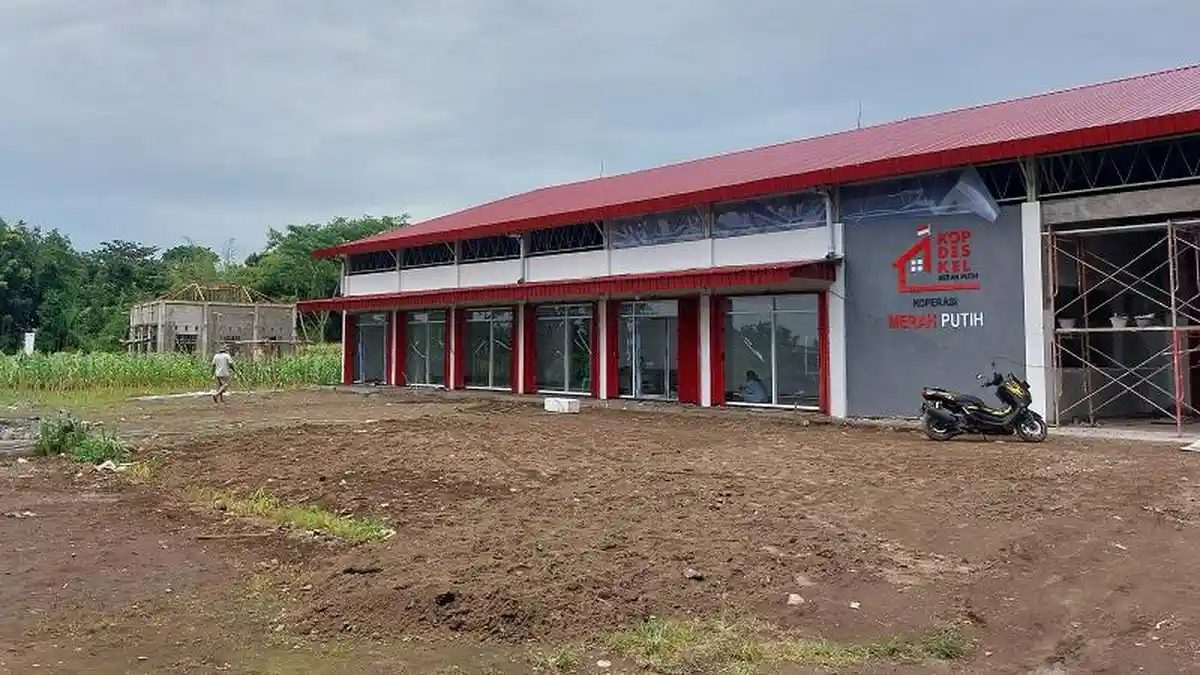
Through collaborative governance, KDMP can develop as a driver of the Village Business Ecosystem, connecting village governments, BUMDes, farmer groups, MSMEs, local shops, financial institutions, and the community in a mutually beneficial value chain.
KDMP and the Future of the Village Economic Ecosystem
A total of 85 Merah Putih Village/Sub-district Cooperatives (KDMP) in Bojonegoro Regency have been officially operating since their launch on May 16, 2026. On the other hand, the formation of cooperatives has reached 396 villages and sub-districts out of a total of 430 in Bojonegoro Regency. This achievement is part of the national KDMP development program. The government itself targets the formation of 40,000 KDMPs by the end of 2026, and as of the middle of this year, around 30,000 cooperative units have been formed in various regions and are projected to begin operating in stages. The scale of this target shows that KDMP is not just a temporary program, but a long-term investment in building the village economy. However, behind these numbers, there is one question far more important than just how many cooperatives have been successfully formed. Will the presence of KDMP strengthen the community businesses that have already grown, or will it instead become a new competitor in the midst of the village economy?
This question is not without reason. Almost every village already has grocery stores, basic food shops, MSME players, farmer groups, and Village-Owned Enterprises (BUMDes) that have been the drivers of the community's economy. Nationally, MSMEs are the backbone of the Indonesian economy, contributing 61% to the Gross Domestic Product (GDP) or around IDR 9,580 trillion, and absorbing about 97% of the national workforce through more than 65 million business units. This significant role shows that the existence of small business players cannot be underestimated in economic development. Therefore, when KDMP began operating, concerns arose regarding the division of roles between village economic institutions. These concerns are certainly natural. Because, if cooperatives run the same types of businesses without clear direction, the potential for competition with existing economic institutions and businesses already run by the community will be difficult to avoid. As a result, the public discussion space is more colored by questions about who will profit and who will lose their market.
This idea is in line with the Business Ecosystem concept introduced by management expert James F. Moore. According to Moore, organizations that are able to survive are not those that rely solely on competition, but those that are able to build networks of cooperation with various parties so that added value is created for all their members. In other words, the success of an organization is no longer measured by how much it grows alone, but by its ability to make other organizations develop as well. This perspective is very relevant to village economic development. KDMP does not have to take over the roles of shops, MSMEs, or BUMDes, but can become a node that connects all the village's economic potential so that they grow together. In the context of a village, this approach can be realized through a Village Business Ecosystem, an ecosystem that connects farmers as raw material providers, MSMEs as product processors, shops as the spearhead of community service, BUMDes as village asset managers, and KDMP as a driver of collaboration so that economic benefits can be felt by the entire community.
Therefore, the local government, together with KDMP management, needs to draw up a map of the division of economic roles in each village. Villages that already have strong shops, MSMEs, and BUMDes do not need to build the same business units, but rather develop functions that are not yet available, such as distribution centers, logistics, production aggregation, or joint marketing. Thus, every institution has room to grow without destroying one another.
Unraveling the Dualism of KDMP Management through Collaborative Governance
Along with the increasingly widespread implementation of the Merah Putih Village/Sub-district Cooperatives (KDMP), one issue has begun to attract attention in various regions: the existence of two leadership elements in cooperative management. On one hand, there are cooperative administrators formed through village deliberation mechanisms and possessing legal legitimacy through a notary deed. On the other hand, there is management or operators recruited nationally to strengthen business capacity and the professionalism of cooperative management. This condition is often perceived as a dualism of management. In fact, if examined more deeply, the main problem does not lie in the existence of these two elements, but in the unclear governance design that regulates the relationship, authority, and responsibilities of each.
These two elements actually exist with different but complementary goals. Administrators elected through village mechanisms have social legitimacy because they have gained the trust of the community and understand local character, needs, and dynamics. They play a role in ensuring that the cooperative continues to operate according to cooperative values and the interests of its members. Conversely, professional management recruited through national mechanisms is expected to bring business competence, the ability to manage businesses in a modern way, build partnerships, and increase the cooperative's competitiveness. In other words, one element provides social legitimacy, while the other provides managerial professionalism. These are not two forces that must be pitted against each other, but two important assets that are actually needed for KDMP to grow healthily.
Problems will arise if the boundaries of authority between the administrator function and the management function are not clearly formulated. Administrators may interfere too far into business operations, while management may also make decisions that should be the authority of the administrators. As a result, the decision-making process becomes ineffective, accountability becomes blurred, and it even has the potential to cause internal conflict, which ultimately reduces the trust of members and the community in the cooperative. In modern organizations, such problems are not solved by choosing one party, but by building a governance system that clearly distinguishes between governance and management functions.
From the perspective of Collaborative Governance developed by Ansell and Gash, the success of an organization is not only determined by who leads, but by the ability of various actors to build trust, agree on common goals, and work through a clear division of roles. This concept might be a proposed solution that can be applied to KDMP, which involves the government, the community, cooperative administrators, and professional management in one institution. Therefore, the concept can be developed into Collaborative Governance for Village Enterprises, a governance model that synergizes the social legitimacy possessed by village administrators with the professionalism of management in developing cooperative businesses. In this model, administrators carry out governance, supervision, and policy direction functions, while management is responsible for business operations, business development, and achieving performance targets. Their relationship is not one of superior and subordinate, but a partnership that strengthens each other.
If this collaborative governance can be applied consistently, then KDMP will not only become a cooperative with a strong organizational structure, but also a driver for the birth of a Village Business Ecosystem. In this ecosystem, KDMP does not work alone, but becomes a collaboration node that connects the village government, BUMDes, farmer groups, MSMEs, local shops, village financial institutions, and the community in a mutually beneficial value chain. The success of the cooperative is no longer measured by the size of its assets or the number of business units it owns, but by its ability to strengthen existing village economic players and create shared prosperity. Thus, the biggest challenge for KDMP is not solving the issue of who has the right to be an administrator, but building collaborative governance capable of uniting all the village's economic potential into a transparent, professional, and sustainable system.