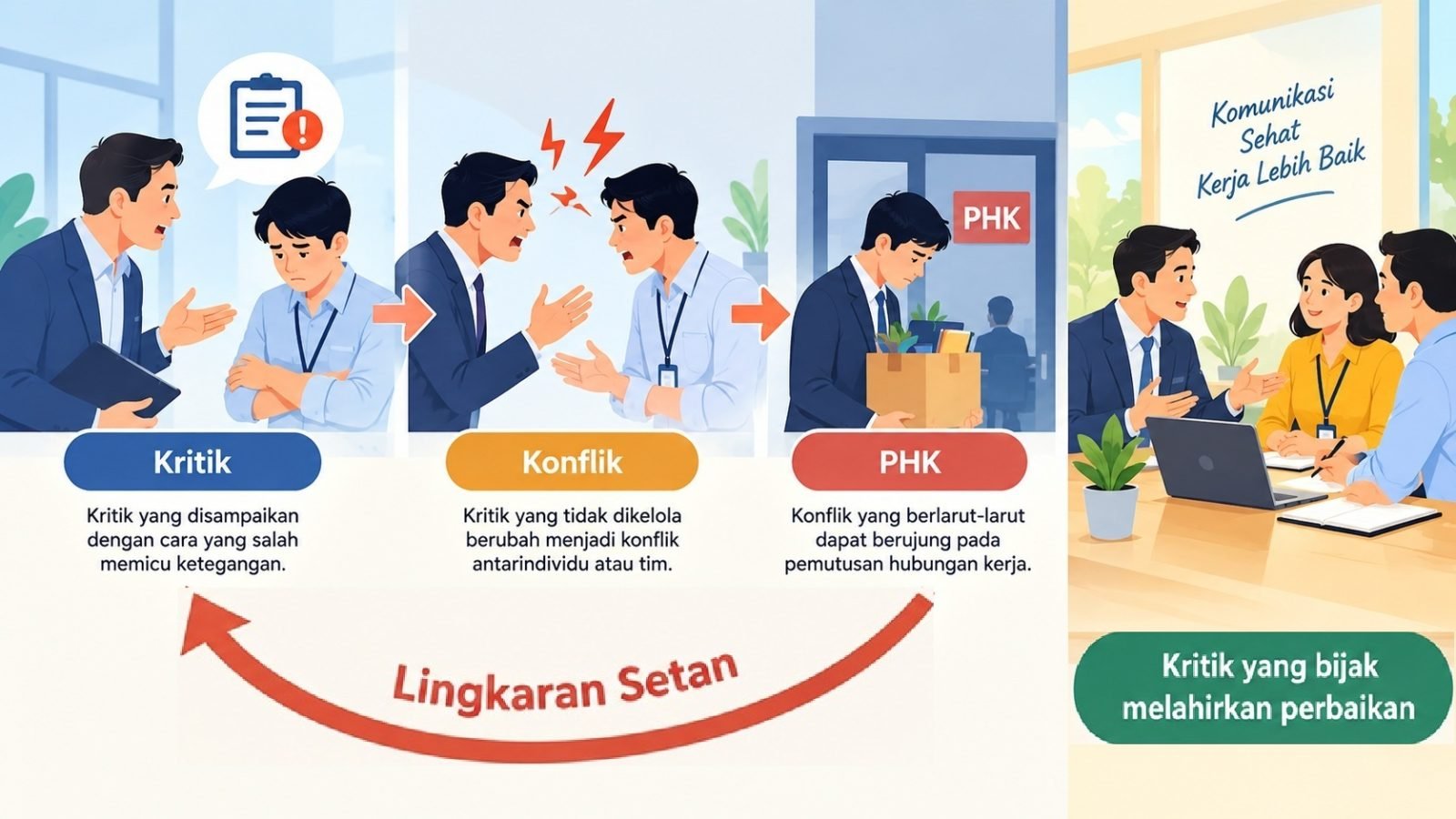
Criticism managed wisely leads to improvement, while criticism handled defensively can turn into conflict that ends in termination of employment.
Introduction
The title with the question sentence was inspired while attending a Scopus article writing training on campus. Among the examples presented by Nasum at that time was that one of the titles that passed used a question sentence, and several events we observed in the foundation's work environment as well as the viral dismissal/termination of a high-ranking official, started from netizen criticism that caused conflict and ended in termination of employment. In the concepts of neuroscience and popular psychology according to Daniel Goleman, we are anti-criticism because our brains naturally identify criticism as a direct threat to survival and self-esteem.
In conflict management and psychology, this resistance occurs due to a combination of biological defense mechanisms, ego, and how we process information. Our brain's Fight or Flight response (specifically the amygdala) cannot distinguish between physical threats (such as being attacked by a wild animal) and social threats (such as being criticized). As a result, the body automatically releases stress hormones that make us want to fight back (fight) or avoid (flight).
We often equate criticism of our actions as criticism of our entire selves. When someone says, "Your report is not thorough," our ego often translates it into, "You are an incompetent person." Humans naturally seek information that supports their own beliefs. Criticism brings conflicting information, so our brains tend to reject or filter it so that we continue to feel "right." When our beliefs or work results are challenged by criticism, instead of changing, we often become even more rigid in defending our initial position to protect our ego.
Evolutionarily, being criticized or blamed can mean we are judged poorly by the group, which triggers a deep fear of being ostracized or losing social status. Often what makes us anti is not the content of the criticism, but the way it is delivered. Criticism delivered in an attacking, judgmental tone, or in public will immediately trigger self-defense.
The Relationship between Criticism, Conflict, and Layoffs
Criticism, conflict, and Termination of Employment (PHK) have a very close cause-and-effect relationship in the dynamics of the world of work. If not managed properly, these three elements form a vicious circle that leads to job loss.
The following is an explanation of how these three things are connected:
1. Criticism as a Conflict Trigger
Criticism in the workplace, whether from superiors to subordinates, between colleagues, or from subordinates to superiors, actually aims for performance improvement, but criticism delivered aggressively in public or attacking personally will trigger conflict. Employees who are criticized feel unappreciated or threatened in their position, so they respond with a defensive or hostile attitude. Criticism is actually a normal thing, especially for performance evaluation. Criticism that only blames without providing solutions makes employees feel unappreciated. And when employees cannot accept objective constructive criticism and instead respond with anger, interpersonal conflict will immediately be created.
When criticism gives birth to unresolved conflict, the work atmosphere will deteriorate. This conflict can occur between colleagues and between superiors and subordinates. Work focus shifts from professionalism to personal tension, toxic work environments, factionalism, gossip, or acts of work sabotage. This happens according to the author's observations while being a cleaning volunteer, criticism from subordinates to superiors and fellow employees arises, among other things, due to the dissatisfaction of one or more employees, because they feel treated unfairly in the distribution of tasks.
2. Conflict Can Lead to Termination of Employment (PHK).
Conflict is a natural part of our lives. In the workplace, in the family, among friends, and even within ourselves, conflict can arise in various forms. Unlike what we often imagine, conflict is not always something that must be avoided or resolved by avoiding it. Conflict management teaches very valuable skills that can help us turn tension and disagreement into opportunities for growth, understanding, and positive change.
Conflict is a situation where two or more individuals, groups, or entities have conflicting opinions, interests, or goals. This can lead to tension, disagreement, or even strife between the parties involved. Conflict can arise in various contexts, including personal relationships, organizations, and politics. Heating conflict can lead to disciplinary action, such as physical fights, work sabotage, or defamation, which becomes a strong basis for companies/institutions to carry out unilateral layoffs. When criticism gives birth to conflict, and that conflict is allowed to drag on without a healthy solution, the impact will lead to layoffs.
3. Layoffs Will Cause New Criticism and Conflict.
Layoffs will reverse the circle, namely layoffs trigger new criticism and conflict; this relationship does not stop after layoffs occur. Layoff policies, especially if carried out en masse or considered unfair, can trigger a wave of new criticism and conflict.
Companies/Institutions will receive sharp criticism from external and internal parties regarding the transparency and fairness of the layoff process. Unilateral layoffs or disputes regarding severance pay often lead to legal conflicts in the Industrial Relations Court (PHI).
Summary of Relationship Flow:
Bad/Defensive Criticism ➔ Interpersonal Conflict ➔ Performance Decline/Violation ➔ Employee Layoffs ➔ Emergence of New Criticism/Conflict.
If we are facing a situation like this in the workplace, we must break the chain of conflict by:
a. Delivering safe criticism
Criticism is delivered wisely, so as not to end in conflict, namely by turning criticism into a conflict management tool using the I-Message method (focus on your feelings, not other people's mistakes) and applying the Sandwich technique (praising before and after criticizing), wrap your criticism between two positive statements. This helps maintain the person's motivation and ego. Acknowledge the efforts or good things they have done then convey the areas that need improvement objectively.
Criticism is delivered wisely, so as not to end in conflict, namely by turning criticism into a conflict management tool using the I-Message method (focus on your feelings, not other people's mistakes) and applying the Sandwich technique (praising before and after criticizing), wrap your criticism between two positive statements. This helps maintain the person's motivation and ego. Acknowledge the efforts or good things they have done then convey the areas that need improvement objectively.
The key is to separate the mistake from the person's self-esteem so they don't get defensive. Criticism should focus on the behavior or problem that occurred, be supported by objective data or facts, and be delivered privately without attacking someone personally.
b. Conflict mediation strategy
Conflict is not always something that must be avoided or resolved by avoiding it. With effective conflict management, it can help us turn tension and disagreement into opportunities for growth, understanding, and positive change. Mediation is a method of resolving disputes or conflicts through dialogue guided by a neutral third party (mediator) to reach a voluntary peaceful agreement. The mediator is impartial, has no right to decide the outcome, and maintains objectivity.
Conflict is not always something that must be avoided or resolved by avoiding it. With effective conflict management, it can help us turn tension and disagreement into opportunities for growth, understanding, and positive change. Mediation is a method of resolving disputes or conflicts through dialogue guided by a neutral third party (mediator) to reach a voluntary peaceful agreement. The mediator is impartial, has no right to decide the outcome, and maintains objectivity.
All information or conversations that arise during the mediation process are confidential and cannot be used as evidence in court if mediation fails. Each party has an equal right to express opinions and proposals. If mediation fails, interpersonal conflict drains emotional energy, damages teamwork, and reduces productivity. Employees whose performance declines sharply due to prolonged conflict can be laid off based on performance appraisal.
c. Legal regulations regarding layoffs
So that layoffs do not cause new criticism and conflict, what must be done is to apply the principles of transparency, fairness, and empathetic two-way communication from the beginning of the process.
Layoffs of foundation employees due to criticism and conflict are regulated based on general labor legal regulations applicable in Indonesia. Foundations are categorized as legal entities with the status of "employers," so the employment relationship between the foundation and its employees is subject to Law No. 13 of 2003 concerning Manpower as amended by Law No. 6 of 2023 (Job Creation Law), as well as Government Regulation No. 35 of 2021.
Dismissal based on personal criticism or conflict cannot legally be done unilaterally or immediately. Indonesian law adheres to the principle that the foundation and the worker must strive to prevent layoffs (Article 151 paragraph (1) of the Job Creation Law). Criticism and conflict do not automatically become a valid reason to fire someone, unless they meet the following elements:
The criticism is delivered by insulting, defaming the foundation, leaking institutional secrets, or triggering conflict that violates the boundaries in the Employment Agreement (PK), Company Regulations (PP), or Collective Labor Agreement (PKB).
Based on Article 52 paragraph (1) of PP 35/2021, if the worker's actions are considered to violate the code of conduct due to the conflict, the foundation is obliged to issue a First Warning Letter (SP1), Second (SP2), to Third (SP3) consecutively before being able to impose layoffs.
If the criticism is delivered in the form of severe slander, fraud, or physical/verbal abuse when a conflict occurs, the foundation can carry out direct layoffs without SP through the "Urgent Violation" scheme (Article 52 paragraph (2) of PP 35/2021), with the note that the criteria for urgent violations have been regulated in writing in the foundation's PP/PKB.
The mandatory layoff procedure is that the Foundation may not fire employees verbally without clarity. The flow that must be passed is the Justification Media for the intent and reasons for the layoff no later than 14 working days before the date of termination of employment. Employees have the right to submit an official rejection letter regarding the layoff within a maximum of 7 working days from the date the notification letter is received.
The Resolution Flow If a Dispute (Conflict) Occurs because the employee rejects the layoff decision, feels their criticism is objective input and not a violation, the resolution is carried out based on Law No. 2 of 2004 concerning Industrial Relations Dispute Resolution (PPHI). Direct deliberation between foundation management and employees in a family manner (maximum 30 working days). If bipartition fails, one party registers this matter with the local Manpower Office (Disnaker) to be mediated by an external mediator.
If Disnaker mediation does not result in an agreement, a lawsuit can be filed with the PHI to be decided by a judge. If layoffs still occur, the foundation is obliged to pay the employee's normative rights, the value of which depends on the reason for the layoff (Article 40 of PP 35/2021); Ordinary Violation Layoffs (After SP3) employees are entitled to 0.5 times severance pay, 1 time Service Appreciation Money (UPMK), and Rights Replacement Money (UPH). Urgent Violation Layoffs employees do not get severance pay, but are entitled to UPH and Separation Money (the amount is regulated in the foundation's PP/PKB).
Closing
Criticism is the spark, conflict is the fire, and layoffs are the fatal impact. The relationship between the three shows that failure to manage criticism and resolve conflict professionally will lead to the greatest loss for both parties, namely the loss of workspace and talent through layoffs. The main key to preventing futile layoffs is to turn criticism into constructive evaluation and manage conflict into a space for innovation.
In conclusion, it can be concluded that layoffs are not the only way out of conflict triggered by criticism. A mature foundation/institution is one that is able to provide a safe container for criticism, so that the conflict that arises is constructive and not destructive. With proper communication management, the three do not have to end as a vicious circle, but rather become a process of organizational maturation.
Moch Suberi, Non-permanent Lecturer at STIEKIA, YAP Management, Advisor to YBU & YPL